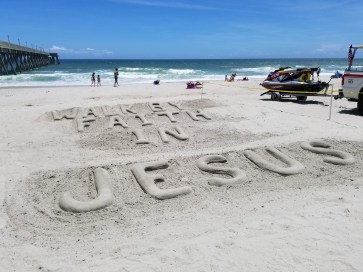

“The Lord has broken through my enemies before me like a breaking flood.” 2 Samuel 5:20
“What good can come of this situation?” Is a question most of us have asked from time to time. We find ourselves in a negative situation where there seems to be no good answer. And you may be feeling anxious about it. Figuratively speaking, you’re starting to think that the walls are closing in on you.
Well, nothing could be further from the truth. Don’t let your emotions run ahead of your decision making. Stay calm, and breath deeply. And let some good old common sense come into your mind. Or in other words: Let go and let God do His work in the situation.
My maternal grandpa was born in a chaotic situation when good choices were few and far between. Even in spite of that, I believe God’s hand was in it, and the best choice was made.
His mother was from one of the most rural areas of Western North Carolina. And it still is. Few outsiders travel to those areas. An outsider brings suspicion on him or herself. I know because I’ve gone looking for headstones throughout WNC. And I have been asked what I was doing there even with NC plates and having a pronounced WNC southern accent.
Back to my grandfather. His entire life story could be summed up in that one phrase, “Let go and let God do His work in this situation.” Through some effort I’ve been able to weave together the highlights of his life. And, in reading it you’ll see what I’m talking about.
First, he is the only grandpa I knew in my growing up years. My Dad’s dad died of a massive heart attack when my dad turned thirteen years old. He was in his forties and had three of his four children still at home. My paternal grandmother immediately started working in the Knoxville, TN school cafeteria. Not much time to grieve back then. All of that happened during the Great Depression.
My maternal grandfather was born to a fifteen-year-old unmarried girl. She was not quite a woman, but no child either. My math tells me she was pregnant at fourteen and turned fifteen a few months before my grandpa was born. She died a few years later giving birth to her second child, also a son, also illegitimate.
My grandpa’s dad was in his early twenties when the teenage girl from down the road delivered his first child, in 1898. He had just started operating the only grocery store in that whole community. That’s where most likely the two met. Was their quick union consensual? I don’t know. All I know is that my grandpa’s dad rejected his first born and despised the ground his son walked on. That I know to be a fact.
My grandpa’s dad did marry later and had one son. I have a picture of that man and he looks a lot like my grandpa. The resemblance between the two is striking and leaves no doubt that they were brothers, right down to both being small frame wiry looking men. Both had fair skin, slicked back trimmed blond hair, that framed narrow faces. The eye set, what I call “the look” is the same on both men.
My grandpa, as a child moved from house to house in that community until he reached twelve years of age. He never talked about his childhood but my mother and her sister have shared some memories of their childhood and what they remembered being told about their parents childhoods.
The 1900 Census shows grandpa’s teenage mother living with her parents, but no mention of a boy toddler in the home. The 1910 Census shows him living with his paternal grandmother who had been widowed just prior to that. Then he was sent across the state line to another relative’s farm to pick peaches in Georgia. From there he went to Rome, GA to the Berry’s School for orphaned children where he learned a trade.
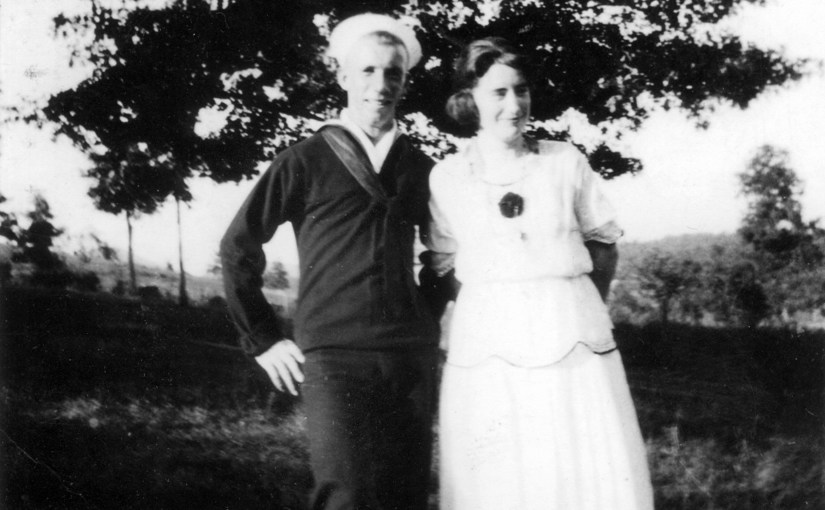
Then, in 1917 he left Berry’s School to enter the Navy. Berry College’s archival department had his name on their attendance roll. It doesn’t look like he graduated but being older he just left.
From there Grandpa caught the train to Atlanta and went straight into the Navy. He sailed for France on a frigate. The early idea of that type of ship was that most everyone was a machinist of some type or other. There were guns on the larger ships that required maintenance, ships engines required maintenance, etc. I have a copy of his discharge papers that shows all his assignments.
Experiencing Rejection Twice
After WWI he comes back to the rural community that he was born in. The place where he was rejected in. The place where his dad still ran the only store there. The place where he didn’t have much of a chance at attending school, if any at all.
That was the place where, in his early childhood he had to go from house to house wondering if he could just stay there long enough to work during the Spring planting season. Or the harvesting season. Or the cold Winter season. And who or where did he get a coat from when it snowed? And we usually have a few snowfalls here in WNC every Winter.
Where did this boy get clothes? And shoes for those cold months? Who took care of him when he gashed his knee wide opened? Did any maternal woman give him just one reassuring hug during those early years? Who showed him how to be a responsible man? Which, he did grow up to become very responsible.
My big question is “Why do we always go back to where we’ve experienced the most pain in our lives? What good can come of that?” I’ve done that too and I don’t have any great nor even a good answer to this question.
If you are thinking closure, then maybe you’re not old enough to know the difference between that or just trying to move on with life. If closure were a creature it would be the most elusive living thing on Earth to catch. There is no trap strong enough or quick enough to catch closure. So, let’s all agree to stop trying to catch it.
Well, from there grandpa moves to the nearest bustling community and meets my granny. They married in the early nineteen twenties. I don’t know the exact year, but my mother was born in nineteen twenty-six, she had two older brothers and one younger sister. They attended a Calvary style church that was in walking distance all of my mother’s growing up years.
About 1930 grandpa almost died from falling off an elevated platform onto a concrete floor at a factory he worked at. In falling he cracked his skull open and had “brain bleed.”
The hospital must’ve been close by because he survived a rare operation. Most people with head injuries died back then before they could get to a doctor. Grandpa’s scalp was sliced open and the skin peeled back. Then, the doctor screwed a metal plate over the crack. Of course, this was all done under anesthesia or morphine induced sleep.
Well, long story short, my grandparents went back to farming near the community my granny was from. They both grew up farming and knew it the best. Plus, the metal plate caused my grandpa to have seizures, so he never worked a regular job nor ever drove after that surgery.
They worked their way into owning fifteen acres of wooded farmland that included a livable house. They closed in a “dog trot” back porch and turned it into an indoor bathroom in 1946. My mother was already married to my dad by that time.
Their two sons joined the Navy during WWII. Both came home from the war, quickly married, and moved off. My mother and her sister worked in the naval yard in Panama City, FL as riveters during some of WWII. Then, they attended Knoxville Business school. It was in Knoxville that they met their future husbands, one being my dad.
My parents settled down about fifty miles East of my grandparents in Asheville, NC. By then they had all of us five kids. A few years later my dad convinced my mother to quit her steady factory job and try an idea he had about getting into the souvenir business near the Cherokee Indian Reservation. That one idea made them millionaires several times over.
My grandparents’ four children had seventeen children, collectively speaking. Of those seventeen; three became teachers or connected to Univ. of TN. One obtained her PhD. Another cousin joined the Navy and made Chief Petty Officer within thirteen years. I’m happy to say that all of us siblings and cousins became the “Salt of the Earth” type of people.
It’s always best to let go and let God takeover our problems. Life is too short to do otherwise.
 devotionsby/patricia jordan